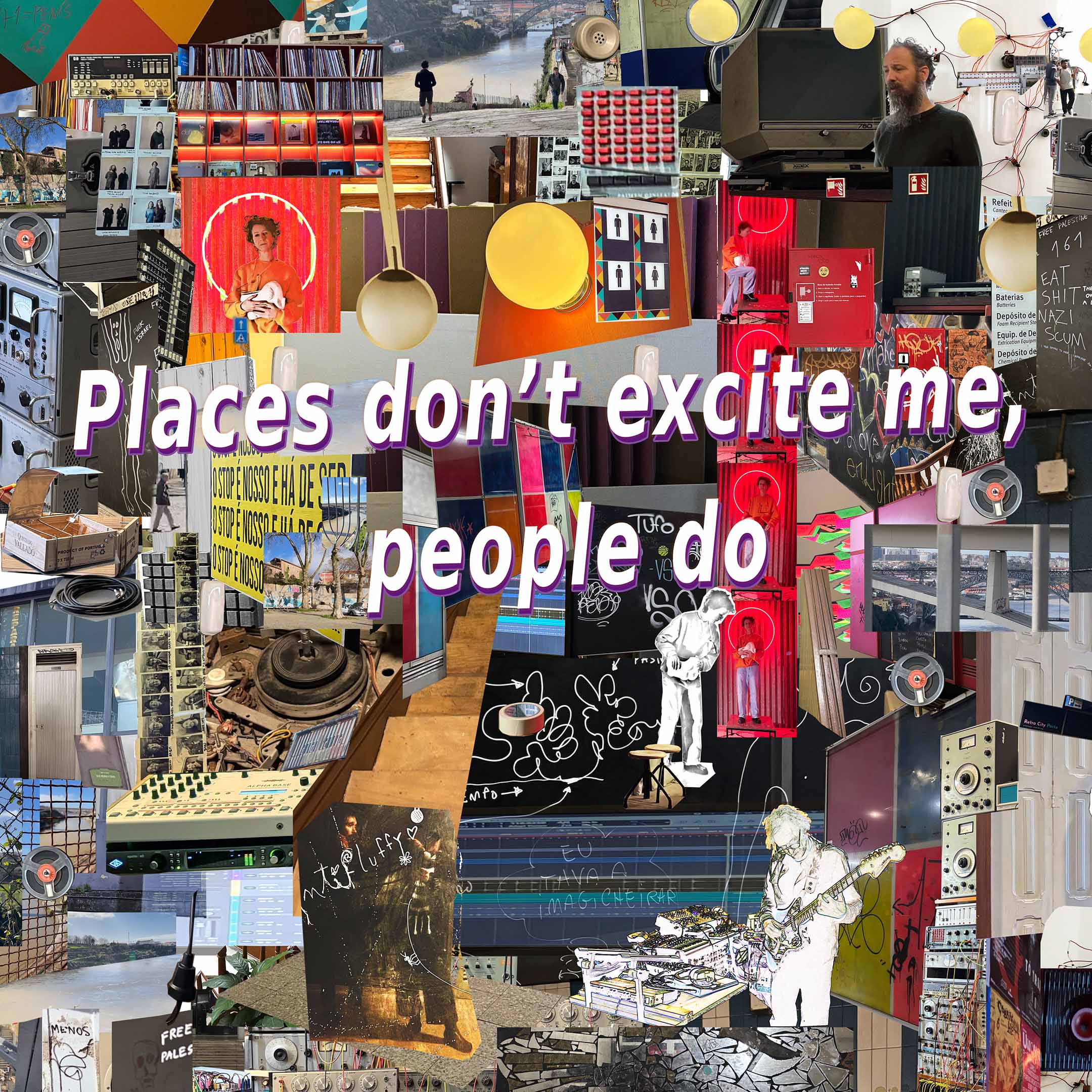
Porto Resounds: Sound, Space and Change
Episode 23 of the TIMEZONES podcast series comes from Porto and is an introspection on how the current social and political climate shapes, and gets shaped by the way we listen to the city. Produced by Sandra Pereira aka Narsadia, the episode listens through the ears of sound artists, experimental musicians and electroacoustic composers, collectives and curators, as well as the cultural spaces, venues and communities that keep them going.
In 2026, Porto’s soundscape is caught between continuity and change. Tourism, rising rents, and waves of new residents are altering its cultural rhythms, challenging artists and curators to find spaces, audiences, and support for their work. Is Porto’s sonic identity being lost, renewed, or rewritten? Through these conversations, we explore the delicate interplay between memory, place, people, and sound in a city at the crossroads.
Credits
A podcast by Sandra Pereira aka Narsadia
Produced by Norient
Featuring: Pedro Melo Segurado (Fiasco Porto), Alexandre Soares, Gustavo Costa (Sonoscopia), Paula Lopes (Hotelier), Luca Massolin (8mm Records)
Artistic Editor: Abhishek Mathur
Project Management: Abhishek Mathur
Outreach/Press: Janina Neustupny
Content Publisher: Rebecca Favale
Video Trailer: Carroll Omuom aka Karrl
Additional Images: Alexandra Côrte-Real and Rafael Paris
Jingle Voiceover: Nana Akosua Hanson
Jingle Mix: Daniel Jakob
Mastering: Adi Flück, Centraldubs
Artwork: Šejma Fere
Listen on




→ Listen to further TIMEZONES episodes
QUOTES
«It's the kind of thing that happens in Porto, if you don't help them, they do it anyway.» Alexandre Soares
«Noise needs a counterpoint which is silence.» Pedro Melo Segurado
«People in Porto were much more interested in doing their own stuff than actually trying to follow a specific trend and that created a very unique music output.» Gustavo Costa
«If you cannot distinguish between something AI generated and a real artist, it doesn't mean AI is good, it means your skills as a listener have degraded.» Luca Massolin
«If you don't have anything to aggregate your people and everything is just aimed towards somebody visiting for a week, then you are actually being part of the problem and not part of the solution.» Pedro Melo Segurado
«We have to maintain the open mind of the sounds.» Paula Lopes
«Porto was a ghost city. In that point and this, I prefer this but we have to rethink the sound of this.» Paula Lopes
«My influence is not music, it's silence, people. What people say, what people don't say.» Alexandre Soares
«I sometimes fear that globalization could lead to a more generic output, Porto losing a bit of its identity.» Gustavo Costa
«The future is independent. It's local and it's multidisciplinary.» Luca Massolin
Featured Artists
Pedro Melo Segurado was born and raised in Marvila, Lisbon, a cultural melting pot shaped by migration and political change. Growing up surrounded by diverse sounds and communities forged a deep understanding of music rooted in people, not just sound.
In 1998, his journey began at Lux, where eight years of exposure to hip hop, opera, electronic music and performance shaped his ear and vision. After moving to Porto, He became part of iconic venues including Plano B, Indústria, and Gare. A chapter at Pernod Ricard brought structure to his research practice, gradually drawing me toward programming. Boa Bao deepened that path.
The need to return to music led him to open Torto in Porto, a natural pairing of spirits and sound. That vision expanded into Fiasco, a community-driven space where neighbourhood, artists, and shared connections coexist and grow.
Follow Fiasco on instagram
Alexandre Soares is a musician and composer born in Porto. He began his career in 1980 as co-founder, guitarist, and first vocalist of the band GNR. In the 1990s, he joined the collective Três Tristes Tigres, whose album Guia Espiritual was named best album of 1996 by Blitz. That same decade, he was recognised as best Portuguese composer in Pop Rock by Público.
His work spans multiple disciplines such as cinema, dance, theatre, and installation art. Notable film collaborations include three works with director João Canijo, two of which screened at Cannes. In contemporary dance, he composed over 15 works for choreographer Né Barros. He has also released music with Osso Vaidoso and regularly performs with Três Tristes Tigres, whose latest album Arca was released in 2025, including a performance at Expo 2025 in Osaka representing the Municipality of Porto.
Follow Alexandre on Instagram.
Gustavo Costa’s sonic vision is characterized by a constant permeability to various musical styles but with a common denominator:experimentation and the constant desire for stylistic renewal. Active in the underground scene since the early 1990s, he maintained an interest and parallel activity in the academic world, studying percussion, musical technologies, sonology, theory, composition and digital media, and teaching at various higher education institutions in Portugal.
In a period of 30 years, Gustavo was part of countless bands and formations from various stylistic spectra, collaborating with hundreds of musicians and performing regularly around the globe. In recent years, he has concentrated a large part of his activity in Sonoscopia, the collective and association of which he is a founder and where he dedicates himself to the sonic exploration through various formats of creation and collaboration.
Follow Sonoscopia on Instagram
Paula Lopes graduated in Communication Design from ESAD Matosinhos in 2000. She worked at various design studios and agencies between 2000 and 2010, in Porto, Braga, and Lisbon. Paula co-created the project Troca-se por Arte, an annual art showcase in Porto's commercial spaces, running from 2009 to 2011. She co-created as well the project Missopo, a culturally oriented guesthouse and restaurant in Porto, from 2011 to 2020. Running from 2018 to the present, she created the project Hotelier, a circle for cultural and artistic experimentation.
Follow Hotelier on Instagram
Luca Massolin has a background as a musician and artist, beginning in the vibrant Italian hardcore punk scene and later developing a path in sound experimentation between electronics and improvisation. He studied contemporary art and philosophy at DAMS, University of Bologna, shaping an interdisciplinary approach that bridges theory and practice.
His career culminated in collaborations with Sonic Youth for Sensational Fix and with the Merce Cunningham Dance Company, for which he worked on the final production Nearly Ninety. He is the founder and owner of 8mm Records, an independent label, record store, and distribution platform with locations at Fiasco, Porto and in Barcelona, now one of Europe’s leading mail order services; the shop has been described by The New York Times as «a mecca for record collectors.»
Follow 8mm Records on Instagram


Trailer
by Karrl
The TIMEZONES podcast series plunges into the world of artists and their practices, asking them to dwell on the challenges and specific contexts of the cities, countries and cultural milieus they inhabit. The artists’ thoughts on their moods, their social, political, and intellectual realities and their philosophies (of life) have been worked into experimental audio collages.
The podcasts run the gamut of formats and content, from straight journalism to experimental and documentary approaches, ethnography and fiction, sound art, and improvisation. The Timezones series endeavors to create new artistic forms of storytelling, listening and exchange across the boundaries of geography, time zones, genres, and practices.
Biography
Shop

Published on April 22, 2026
Last updated on June 10, 2026
Topics
Why do people in Karachi yell rather than talk and how does the sound of Dakar or Luanda affect music production?
From Bangladeshi electronica to global «black midi» micro scenes.
From Muslim taqwacore to how the rave scene in Athens counters the financial crisis.
Can a bedroom producer change the world? How do artists operate in undersupplied conditions?
About fees, selling records, and public funding: How musicians strive for a living in the digital era.
How do acoustic environments affect human life? In which way can a city entail sounds of repression?
Special
Snap