Hip hop has always been closely connected to the place it is made. For the German rappers Ebow, Apsilon, and Nashi44, this place is not defined by national narratives but post-migrant experiences. Sharing them through their music, they create communities for empowerment and solidarity.
«Being German» – what does that mean? Philosophers like Kant and Nietzsche or writers like Goethe and Böll helped establish the image of Germany as a country of poets and thinkers. But how representative is this self-image still in 2024, at a time when the narrative of Germany as a society of immigration is manifesting itself more than ever? Commenting on life in German society today, challenging ideas of home, place, belonging, and «being German», are German rappers. The big difference is that the poets and thinkers today are no longer called Johann and Friedrich, but Ebow, Arda, or Kim-Thu.
Since the late 1980s and early 1990s, German rap in particular has developed into a polarizing and simultaneously progressive artistic space in which Black and People of Colour (BPoC) have repeatedly addressed and criticized their own experiences of racism and marginalization, in contrast to the experience of the white dominant society in Germany. Rappers like Ebow, Apsilon, and Nashi44 blow away the romanticism of the past with their punchlines and are more committed than ever to placing post-migrant experiences and stories at the center of their music.
I suggest that German rap – as an artistic space for self-actualization and discursivity – can be interpreted as transtopian, a post-migrant place of negotiation, mediation, and transition. Transtopia (German: Transtopie) is a concept coined by the German–Turkish migration researcher and social scientist Erol Yıldız. It functions not as a physical but rather an imagined idealized space, in which post-migrant identities do not passively persist in their victim role characterized by marginalization, but rather address their ambivalent relationship to Germany as a (home) place. More than ever, German rap acts as a place where «being German» is questioned, prevailing social norms are deconstructed and, at the same time, post-migrant ways of thinking and multi-ethnic realities of life come into focus or serve as a starting point.
Ebow: By the Community, for the Community
The Berlin-based rapper Ebow is one of the figureheads of a progressive, post-migrant community who is using her music to advocate for more visibility, acceptance, and a say in the public discourse on her own identity. As a queer Kurdish woman of Alevi faith born in Germany, Ebow’s life has been characterized by intersectional experiences of discrimination in many ways since her childhood. First and foremost is the awareness that there is a lack of visibility and awareness of the realities of her life in this society: Ebow is equally affected by the racism of the white dominant society in Germany as she is by Turkish nationalism and racism due to her Kurdish background. As an Alevi woman, she also experiences anti-Alevi racism and, as an openly queer person, queer hostility and sexism. Rap serves as her safe(r) space to express herself.
On her third studio album, Canê – Kurdish for darling or soul – released in 2022 (Virgin Music), the rapper dedicates two tracks to her ambivalent relationship to concepts such as home, place, and belonging: «Dersim62» and «Giesing81». As her parents’ original home and the site of the last major Kurdish uprising in Turkey in the 1940s, Ebow celebrates and acknowledges her Kurdish roots in the first track and takes a clear political stance: «Free my people, free my people / Kurdistan, free my dreams» (original: Free my people, free meine Leute / Kurdistan, free meine Träume). This is contrasted in the latter song by her attachment to the Munich district of Giesing, where she grew up. For a long time, Giesing was considered a precarious neighborhood, rather unpopular with the white majority society due to the high poverty and immigrant rate.
Following Yildiz’s concept of transtopia, Ebow’s songs and her artistic work in general reflect her understanding of identity and belonging. With and through her music, she seeks to cultivate a space of solidarity in which her community is strengthened – and creates places of empowerment and solidarity in reality: in 2020 and 2023, Ebow and the team of her label ALVOZAY organized a festival in Berlin, which sought to create a safer space for the queer BPoC community with several workshops, live performances, and DJ sets.
Apsilon: Between Alienation and a Sense of Home
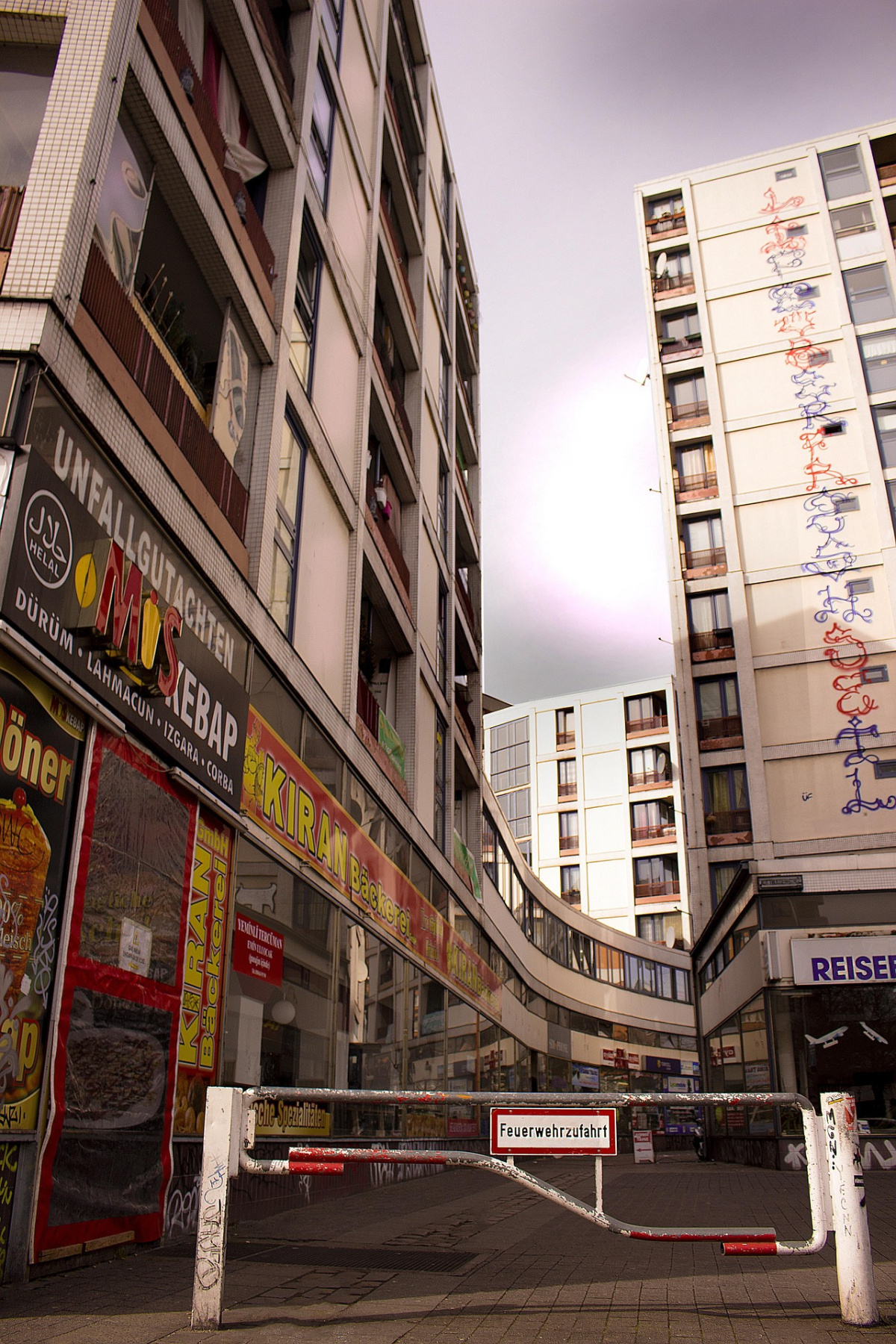
Born in Berlin at the end of the 1990s, rapper Apsilon, who is of Turkish origin, grew up in the Berlin district of Moabit, where he still lives today. As a part of Berlin-Mitte, north of Tiergarten, Moabit is considered a multicultural neighborhood. On the one hand, it is characterized by prestigious locations such as Berlin Central Station and the Bellevue Palace (the official residence of the German Federal President), and on the other by areas such as Turmstraße, where many Turkish restaurants, cafés, and supermarkets can be found.
Since his debut in 2021, Apsilon has been known for criticizing current social conditions in his songs, particularly problems related to racism and capitalism. When describing his own post-migrant identity as a German rapper of Turkish descent, Apsilon outlines the historical background and discriminatory experiences of his grandparents as guest workers in Germany and – similar to Ebow — the current experiences of the second, third, and fourth generation of German Turks, to which he belongs.
In Apsilon’s case, all his experiences of marginalization and discrimination within the white German dominant society lead him to reject identification with a national state personally. The rejection of «being German», which Apsilon emphasizes above all in the song «Köfte» from his first EP, Gast (Four Music 2022; English: guest), results in a general feeling of homelessness, the perception of always feeling foreign and not belonging to German society.
Ich brauchte 23 Jahre, bis ich merkte, dass ich statt zweien keine Heimat habe, außer meine eigene Straße und den Kiez, in dem wir war’n, ja, die Beats, auf die ich sprach
Nein, keine Heimat eins und auch keine Heimat zwei, Nur der Streit mit dem, was sich in beiden Ländern so rumtreibt […]
Deutsch steht auf unserem Pass, doch wenn’s ihn’n passt, ja, sind wir nur Schmutz Ich bin nicht enttäuscht, ich hab’ nix erwartet.
Ich bin nicht Deutsch, wenn du mich fragst Ich integrier’ mich nicht in euren Markt.
It took me 23 years to realize that instead of two I have no home except my own street and the neighborhood we were in, yes, the beats I spoke to
No, no home one and no home two, Only the conflict with what’s going on in both countries [...]
German is written on our passport But if it suits them, yes, we’re just dirt I’m not disappointed, I didn’t expect anything I’m not
German, if you ask me, I’m not integrating into your market.
Apsilon: «Köfte» (2022) While he rejects a supposed German identification, at the same time there is also a strong and identity-forming connection to the Berlin district of Moabit, where he grew up. For the rapper, belonging and identification are therefore constituted more through a personal connection. In an empowering and solidarity-based sense, Apsilon therefore increasingly emphasizes his connection to Turkish culture in his songs and creates – according to a transtopia – an alternative space for the expression of post-migrant, hybrid identities which finds a verbal vanishing point in his neighborhood.
Nashi44: With «Asian Berlin Pussy Power» Against Anti-Asian Racism
The Vietnamese–German rapper and singer Nashi44 was born in the Berlin district of Neukölln in the mid-1990s. As the daughter of a German father and a mother from Vietnam, she was confronted early on with the clichés that Asian people have to deal with in the German majority society. Such experiences of «othering» and discrimination not only shape the artist’s self-perception. They also lead to a bonding identification with the predominantly Turkish and Arab communities living in Neukölln, whose realities of life are characterized by similar experiences.
Last but not least, this connection is also expressed in her artist name: the 44 in Nashi44 stands for the former postcode of the Berlin district. She describes her music as «Asian Berlin Pussy Power» – a further indication that her own identity is defined less by a rigid and supposedly homogenous concept such as «being German». In fact, the identification process takes place through the recognition and appreciation of one’s own hybrid identity, which is permeated by dichotomies and discrimination and in which one’s own neighborhood or district (Neukölln for Nashi44, Moabit for Apsilon or Giesing for Ebow) is often much more influential.
Rap serves as an outlet for Nashi44 to use her empowering songs to protest against prevailing social injustice in Germany on the one hand and to demand visibility and respect for her own ethnic Vietnamese–German community and culture on the other. This endeavor culminated in the spring of 2022 with the release of her first EP entitled Asia Box (Record Jet). With her single «Aus der Pussy» (Out of the Pussy) in 2021 (Record Jet), the rapper delivers a quick-witted answer to the most common of all everyday racist questions that BPoC regularly hear: «Where are you (really) from?»
German Rap as a Transtopia
Ebow, Apsilon, Nashi44 stand for a new generation of post-migrant rappers who not only reclaim terms like «Kanak» in a positive way but also (re)conquer spaces and demand more visibility and acceptance as part of this German society now fundamentally characterized by migration.
So, when it comes to the question of German identity and how «being German» is defined in the 21st century, it is not enough to simply refer to the German figureheads of the past mentioned in the introduction. Today’s poets and thinkers are called Ebow, Nashi44, or Apsilon – and they rap. As a musical form that focuses heavily on language, rap demonstrates like no other style of music how powerful and subversive it can be to raise one’s voice and use biographical stories to counter the dominant normative society with one’s perspectives and concepts. By addressing and sharing their post-migrant, hybrid reality characterized by multiple discrimination, artists like the ones mentioned create a transtopian space of identification and empowerment.