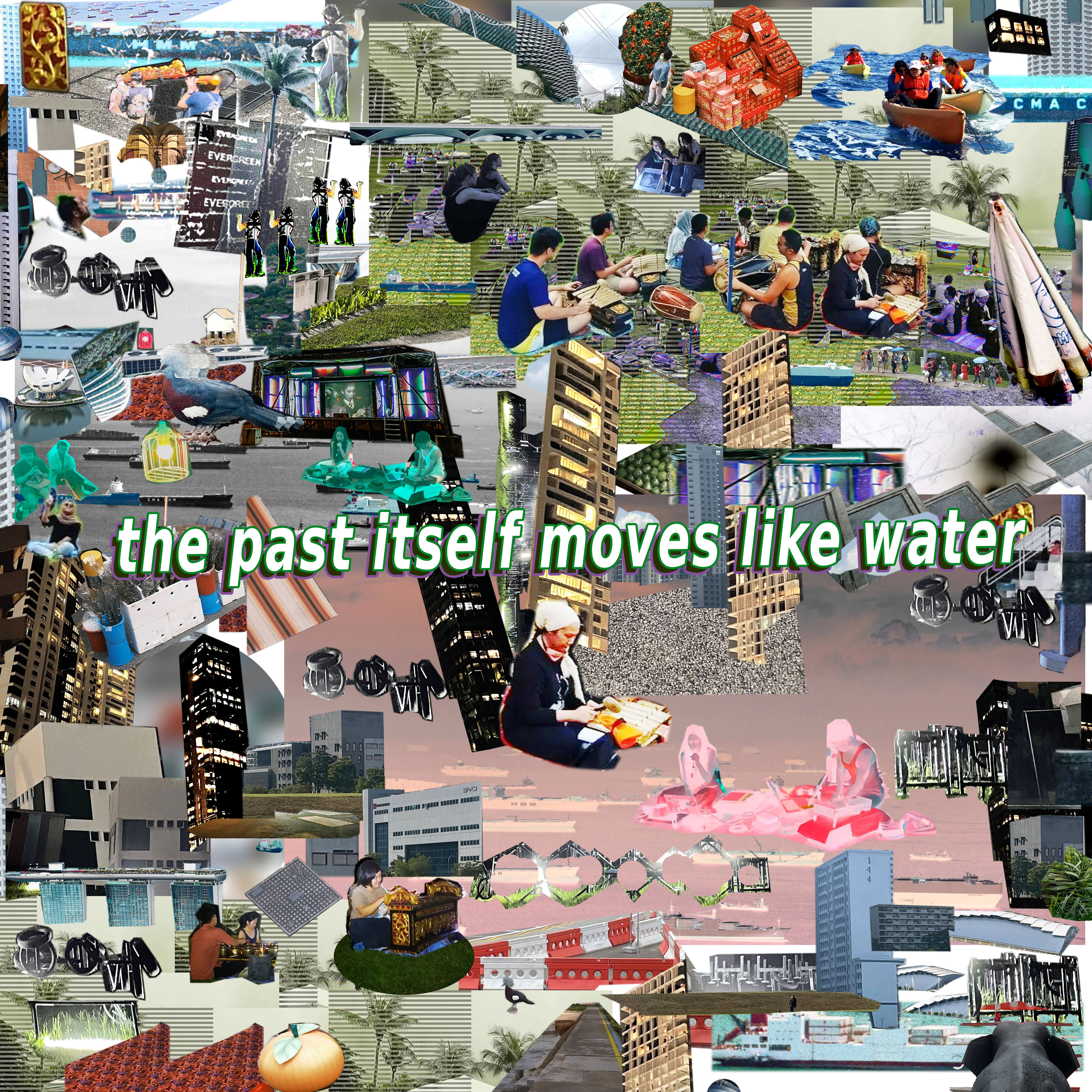
Singapore: Archipelagic Drift
Episode 24 of the TIMEZONES podcast series comes from Singapore. Producers Zachary Chan and Rosemainy Buang contemplate what it means to live on an island, yet feel estranged from the sea. Exploring the histories that lie beneath the waters that surround them, they examine what memories continue to circulate through rivers, tides, and rain long after they have been forgotten on land.
Moving through Singapore and the Malay archipelago, this episode gathers voices, songs, and personal stories that are carried across the waters of Southeast Asia. Stories of migration, ecological destruction, colonial violence, grief, menstruation, spirits, and longing surface and recede like tides. Water becomes a body that remembers. What might return to us when we begin listening to what the currents have carried all along?
Credits
A podcast by Zachary Chan and Rosemainy Buang
Produced by Norient
Featuring: Jan Mrázek, Preciosa de Joya, jee chan, Suyatni Sayano, Sim Hoei Kiam
Artistic Editor and Project Management: Abhishek Mathur
Outreach/Press: Janina Neustupny
Content Publisher: Rebecca Favale
Video Trailer: Carroll Omuom aka Karrl
Jingle Voiceover: Nana Akosua Hanson
Jingle Mix: Daniel Jakob
Mastering: Adi Flück, Centraldubs
Artwork: Šejma Fere
Artwork Quote: Zachary Chan
Listen on




→ Listen to further TIMEZONES episodes
QUOTES
«…we went to these so-called isolated communities, and we realized they are not isolated at all.» Jan Mrázek
«Outside every garden, if you have a wall, it has to be balanced by an equivalent amount of destruction. All the green and wealth are balanced by wasteland around.» Jan Mrázek
«Despite being one small fragment of a vast archipelago, there is little sense of the sea or of the neighbouring islands that surround us.» Zachary Chan
«Paradoxically, Singapore is aligned with the Global North. Its economic power and infrastructural polish set it apart from the region, even as our prosperity depends deeply on the labour, land, and resources of our neighbours.» Zachary Chan
«I’m working on rivers, and what is interesting is this word in Javanese, it’s nerimå, which is basically, menerima, which is to receive, or to accept your fate.» Preciosa de Joya
«To think of Singapore is inseparable from the sea. The island’s histories, migrations, and imaginaries are shaped not only beside water, but by water itself.» Zachary Chan
«…this understanding of the bengawan solo as not just a haunted place, but this vessel that carries actually spiritual life.» jee chan
«I think I wanted to create quite a minimal choreography that was gesturing to the river as the main actant or the main character in the film.» jee chan
«Water appears not as a backdrop but as an agent, a witness, a keeper of what has been submerged and what refuses to disappear.» Zachary Chan
Featured Artists
Jan Mrázek grew up in erstwhile Czechoslovakia (present day Czech Republic) and trained as a violinist at the Prague Conservatory before turning to Javanese and Balinese gamelan. He studied art history and Japanese at the University of Michigan and completed a PhD at Cornell on Javanese shadow puppet theatre, based on extensive fieldwork. After postdoctoral research at Leiden University on traditional arts and modern media, he taught at the University of Washington and joined the National University of Singapore in 2003. His research spans Southeast Asian performing arts, travel writing, maritime worlds, and Czech encounters with colonial Southeast Asia. He founded the NUS Singa Nglaras Gamelan Ensemble and continues to teach through fieldwork, music, and travel.
Follow Jan Mrázek on Instagram
Preciosa de Joya is a scholar of Southeast Asian Studies and Philosophy and a lecturer at the College of Interdisciplinary and Experiential Learning, Singapore University of Social Sciences. She has published on Filipino and Indonesian philosophy. Her current research focuses on Java, and she teaches courses that explore storytelling as a mode of knowledge-making, including a field-based programme in Yogyakarta that engages with local storytelling traditions. Her dissertation, entitled In Search of Filipino Philosophy, is a study of the intellectual landscape – the personages and the struggles involved in the shaping of philosophical practices in the Philippines, but also a questioning that explores the possibility of philosophical thinking beyond the spaces of academic discourse.
Follow Preciosa de Joya on Facebook
jee chan (all pronouns) is an artist working in the fields of dance and expanded choreography. Their work is concerned with questions surrounding the displaced body and what it can perform. Characterized by hybridity and syncretism, their practice engages with oral histories, ancestral epistemologies and the representation of (auto)biographies, particularly among the contexts of island Southeast Asia. A member of the inaugural artistic cohort at the Rose Choreographic School (Sadler’s Wells, London), their transdisciplinary work has been presented at Tanzfabrik Berlin, Institute of Contemporary Arts (London), DOK Leipzig and the Liveworks Festival of Experimental Art (Sydney). They live between Singapore and Berlin.
Follow jee chan on Instagram
Suyatni Sayano has stories flowing through her veins. Born to a Javanese father and Singaporean mother, she grew up knowing the river banks of Sembawang. Suyatni has raised four children and two grandchildren, all of whom love her fiercely, for she keeps them fed artfully with stories, strength and sambal goreng.
Sim Hoei Kiam was born sometime between 1936 and 1937 in Khuntien, near Pontianak, Indonesia. Her exact date of birth was never recorded. The third of thirteen children, she spent much of her childhood caring for her younger siblings and performing domestic labour, as girls were rarely allowed formal education at the time. She was later married off through an arranged marriage and gave birth to her first daughter in Khuntien. Amid rising anti-Chinese racial tensions in Indonesia, her family fled and eventually settled in Singapore. Their early years there were marked by poverty and instability, but through her resilience, resourcefulness, and determination, Sim Hoei Kiam raised three children and built a better life for her family.
The participants include family members of the collaborating artists, whose stories and memories form part of the project's intergenerational inquiry.
Trailer
by Karrl
The TIMEZONES podcast series plunges into the world of artists and their practices, asking them to dwell on the challenges and specific contexts of the cities, countries and cultural milieus they inhabit. The artists’ thoughts on their moods, their social, political, and intellectual realities and their philosophies (of life) have been worked into experimental audio collages.
The podcasts run the gamut of formats and content, from straight journalism to experimental and documentary approaches, ethnography and fiction, sound art, and improvisation. The TIMEZONES series endeavors to create new artistic forms of storytelling, listening and exchange across the boundaries of geography, time zones, genres, and practices.
Biography
Biography
Published on June 10, 2026
Last updated on September 09, 2026
Topics
Why do people in Karachi yell rather than talk and how does the sound of Dakar or Luanda affect music production?
Ecology describes the relationships among living organisms. At Norient, we add sounds and music, asking, for instance: what does a field recording tell about the environment it was recorded?
What happens, when artists move from one to another country? For example, when an Arab artist replaces the big tractors in her the village with big jeeps of the West.
Why Asia is not a continent and how the aesthetics of the NON Worldwide collective create new utopian notions of multi-centred origins.
From Pakistani wrestling practice «kushti» to muezzin singing contests in Turkey.
Special
Snap