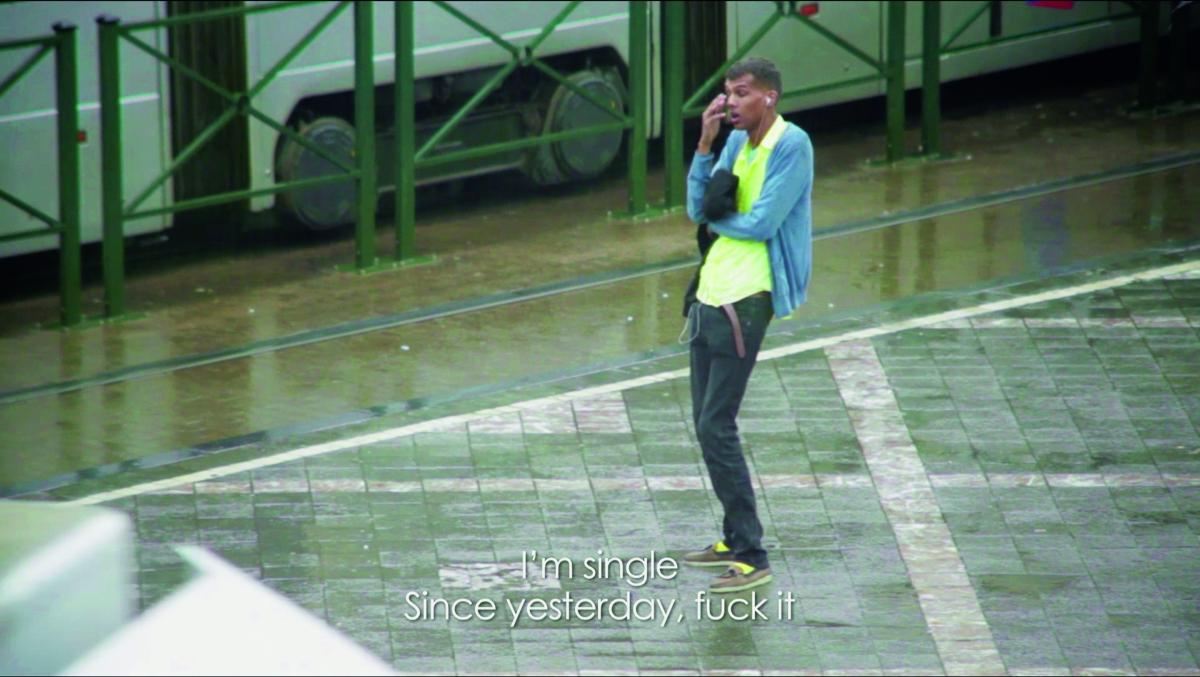
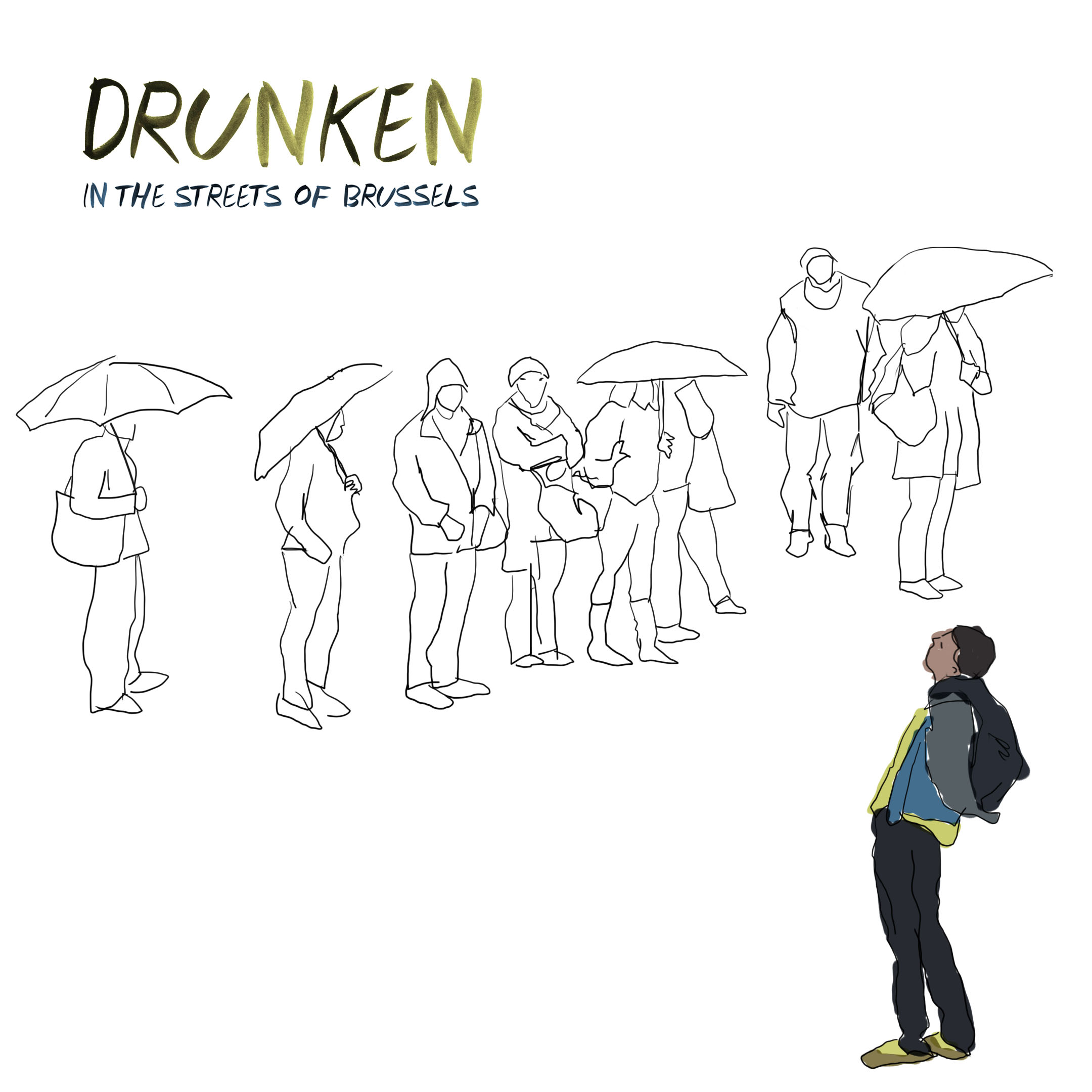
L’aube. Le jour se lève timidement sur Bruxelles. Paul Van Haver, alias Stromae, débraillé, pitoyable et «un peu fort bourré» titube sur les rails du tram au cœur d’un petit matin pluvieux. Le dandy a visiblement passé une très mauvaise soirée et picolé toute la nuit. Les vidéos amateurs filtrent sur YouTube. Les commentaires pleuvent. Les critiques fusent: Stromae serait passé du côté obscur de la peopolisation. From the Norient book Seismographic Sounds (see and order here).
Tout faux. Trois jours plus tard, il donne sa réponse avec un clip: une caméra cachée. En effet, les déambulations alcoolisées de Stromae n’étaient qu’une mise en scène avec, en guise d’épilogue, le clin d’œil final d’un artiste à jeun et lucide du pouvoir du buzz en 2013.
Ce choix n’est pas innocent. Filmé de manière traditionnelle, cette histoire de mec fraîchement largué par sa petite amie n’aurait été qu’un clip anodin, une histoire de rupture comme tant d’autres. En optant pour cette méthode de mise en scène, Jérôme Guiot, le réalisateur, dépasse le banal mélodrame. Avec ce clip, il offre une vraie réflexion sur la tyrannie du buzz. En captant des badauds qui préfèrent filmer plutôt que tendre la main, il montre des anonymes qui, par la toute puissance des clics et des «like», ont le pouvoir de salir leurs idoles d’hier.
Stromae respire la «brélitude»
A écouter «Formidable», on croirait entendre Jacques Brel revisité par l’électro, les sons cubains et la rumba congolaise. Sensation renforcée lorsque l’on visionne le clip: de par son phrasé, ses mimiques et son incroyable expression corporelle rappelant le «non Jef t’es pas tout seul» du Grand Jacques – comme le chansonnier est appelé en France et en Belgique –, Stromae respire la «brélitude», et par la même occasion transpire sa «belgitude». Stromae est belge, du bout de ses mocassins jusqu’à l'extrémité de son nœud papillon: accent rocailleux, mélange de tragique et de légèreté, culture de l’absurdisme et d’un fatalisme joyeux, sans oublier ce zeste d’autodérision permanent servant à décanter l’amertume tenace.
Ce clip a été stratégiquement tourné sur le goulet Louise, véritable carrefour séparant le haut et le bas de la ville de Bruxelles, combinant arrêt de tram, rond-point constamment embouteillé et se trouvant à proximité d’un commissariat et du Palais de justice. De quoi allier du dynamisme visuel à un maximum de possibilités d’interactions décevantes (les passants filmant un Stromae ivre) ou cocasses (la discussion avec les policiers).
La confrontation avec l'ordre locales
Il est d’ailleurs intéressant de s’attarder un peu plus sur la séquence confrontant le chanteur aux forces de l’ordre locales. Ce qui pourrait n’être qu’un détail résume pourtant parfaitement cette mentalité «bonhomme» typiquement belge. Là où dans d’autres contrées la maréchaussée aurait fait preuve de moins de philosophie, les flics made in Bruxelles se montrent familiers et débonnaires. Sans tomber dans les généralités réductrices, cette approche éminemment bienveillante, démontre que les Belges, dans leur grande majorité, qu’ils soient de simples pékins ou qu’ils portent l’uniforme, préfèreront toujours le dialogue à la sanction, la souplesse à la rigueur.
Biography
Maxime Pasques est réalisateur et scénariste belge. Il se lance dans le métier en réalisant des clips aux univers décalés et loufoques pour des groupes hantant la scène musicale de son pays (Soldout, Sharko), avant de s’attaquer à la publicité.
The second Norient book «Seismographic Sounds: Visions of a New World» introduces you to a contemporary world of distinct music and music videos. Written by 250 scholars, journalists, bloggers and musicians from 50 countries.
What is it to be a voyeur in a world where everybody sees each other? What’s the difference between obsessed observation and the mundane swiping through Instagram?
In this photo series we get an insight into the musical underground of Finlands capital Helsinki. Here, the photographer captures a – in his own words – «positive side» of loneliness. A photo series by Antti Ahonen. From the Norient book and exposition Seismographic Sounds (see and order here).
Click on the title image to explore the photo series.
Solitude is a very important thing for us Finns. It is a bit like loneliness in Japan, but not so posh. Sometimes we have to go into the woods to be alone, or spend a night out with friends without saying anything to anyone. Mostly it is a positive thing, it only turns negative if we are forced to be alone against our will. This series follows various underground bands from Helsinki who manifest this positive side of loneliness. The photos are dark, but never gloomy or depressed. These bands have all grown from the same fertile underground between visual arts and music in Helsinki.
This photo series is part of the Norient exhibition Seismographic Sounds and was published first in the correspondent Norient book.
Biography
Antti Ahonen is a photographer from Helsinki, Finland, specialized in experimental live performances. His background is in visual arts, but he has worked widely in the fields of photography, sound, media and performance art.
Though today we often consider churches and their carillons as disturbances to our well-deserved sleep, they were formerly used by cities to display grandiosity and importance. In this sequel of the Sampling Stories we trace the history of the bells of the biggest church in Rotterdam, the Grote of Sint-Laurenskerk. Its bell sounds play an important role in the tracks of the compilation 010 (Fog Mountain Records 2016), released by RE:VIVE, an initiative from the Netherlands Institute for Sound and Vision that aims to bring together archives and artists to create new music out of and inspired by curated sets of archival material. While RE:VIVE's Gregory Markus unfolds the history of the church, Norient invited the artists from the compilation to tell us about their sampling strategies when processing bell sounds from the church in question.
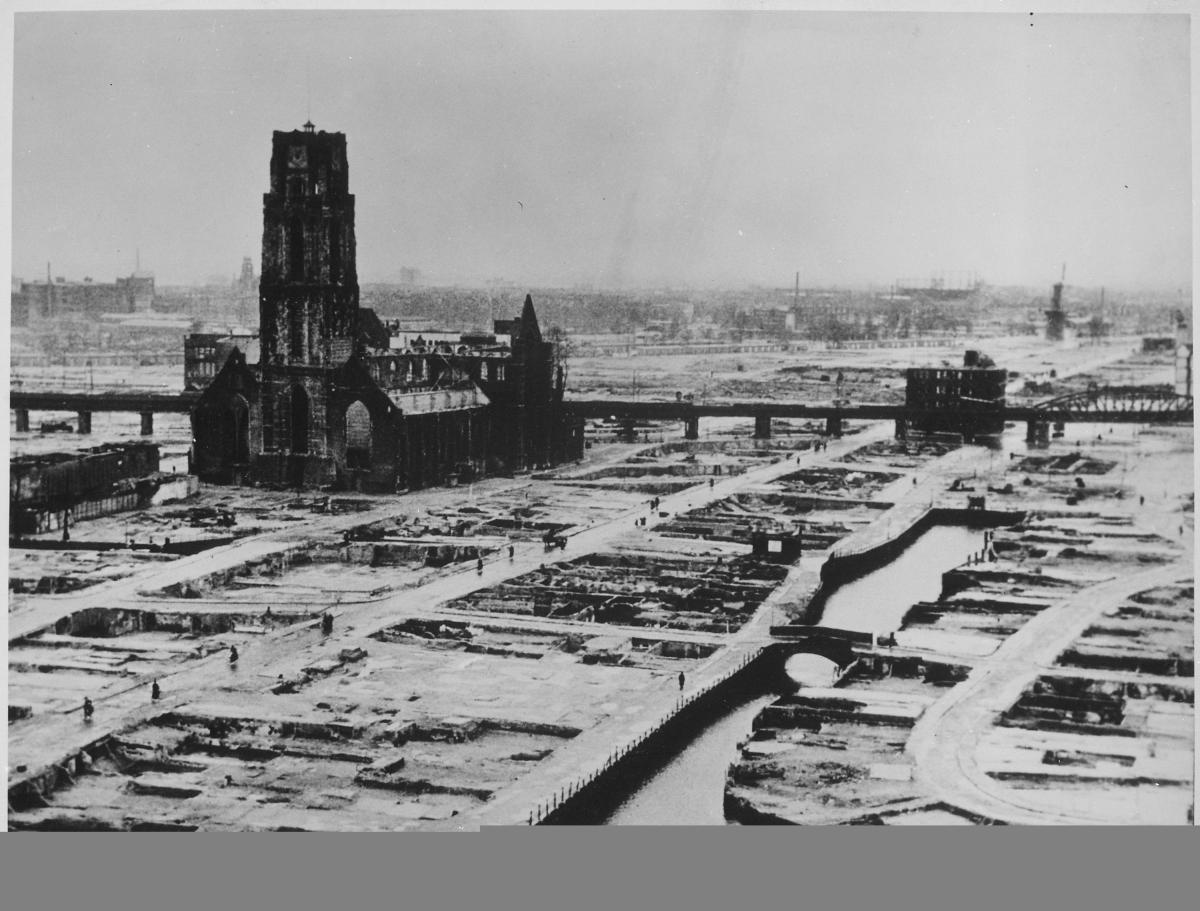
In May 14, 1940, the city of Rotterdam was devastated. A thriving medieval metropolis that served as the key entry point for the rest of the world seeking to enter Europe was reduced to rubble. By the numbers, 25,000 homes, 2,500 stores, 775 warehouses, 65 schools were destroyed and somewhere between 700 and 900 people lost their lives (City Guide Rotterdam 2019). This event has gone on to define their city. Its looming futuristic sky-line, modern architectural marvels, juxtaposed with post-war concrete blocks (and a sliver of remaining medieval houses) make Rotterdam feel more like a second-class American urban area – like Cleveland or Des Moines – than a Dutch city.
For RE:VIVE, once we did our Damrak compilation where every track was inspired by Amsterdam and composed out of archival sounds made in the city we knew that Rotterdam had to be next because we needed to hear how artists would interpret the Netherlands «second city». Damrak raised eyebrows since it didn’t sound like canal houses and tech-house, it was clear from the sounds and images that there was more to the city than what draws millions to it each year. Damrak exposed obfuscated aspects of Amsterdam’s history. We hoped then that with 010 and the shift to Rotterdam, instead of exploring the hidden parts of the city we’d celebrate the obvious this time: ship horns, port mechanics, industrial constructions with hints of hope, struggle, and progress.
The archival sounds in the sample pack (from the large treasures of the The Netherlands Institute for Sound and Vision; access full sample pack for 010here) didn’t lend themselves to melody. The most prominent sounds were the Port of Rotterdam’s rhythmic churning sounds, incredible ship horns, and church bells. Specifically, the bells of the St. Laurenskerk which would go on to bookend of the compilation, solemnly introducing and majestically concluding the journey.
From Destruction to Restoration
The Grote of Sint-Laurenskerk is a Protestant church built between 1449 and 1525. Originally it was a Roman Catholic church, but during the Reformation of 1572, it was converted to Protestant. The structure is the last remaining relic of the gothic, medieval Rotterdam, and it looks severely out of place in the current city center. To an unknowing eye one would think the church came later almost like Saint Patrick’s Cathedral in New York City.
However, one could argue the church did come later. Following the Rotterdam Blitz on May 14, 1940 the church barely remained with just the walls and tower left standing. It’s important to note that there’s a historical belief that Rotterdam almost wasn’t bombed – that the bombing was perhaps an accident because the Dutch army had surrendered or sought to extended negotiations.
It didn’t take long for restoration talks to begin the following June, and by September it was assessed that restoration was possible but would be expensive, especially during wartime austerity. Many plans for the church were proposed, including total demolition, the restoration of the tower but construction of a modern church or to simply leave the ruins as a memorial. It wasn’t until 1947 that a plan for a full, original restoration was agreed upon. In the words of the Queen, «and the answer shall be: naturally the tower will be rebuilt because Rotterdam was, is, and always will be: Rotterdam» (Konigin in St-Laurens 1952).
The Carillon
What makes the story of the St. Laurenskerk special is not just the cliché about Rotterdam as a «phoenix» but more specifically, its bells. Church bells are a sound that dominate almost every European city. Millions of people flock to main squares simply to hear church bells ring out. They echo across small towns and landscapes and, more often than not for the unlucky few living next to them, are an early morning wake-up call. To an untrained ear, bells might just sound like the clangy clang of massive metal objects. In reality, their nuance and tonal capacity is an elegant, mathematical mystery of early sound design perfected by two Frenchmen in the Low Countries nearly 400 years ago.
The story goes that on August 23, 1638, Descartes wrote to a colleague named Marin Mersenne and proclaimed, «In Utrecht lives a blind man with a great musical reputation, who regularly plays bells. I have seen how he elicits five or six different sounds on each of the largest bells without touching them, but only by coming close to their sound rim with his mouth» (Rombouts 2014). This gentleman was named Jacob van Eyck and indeed was blind but had tremendous hearing capacity. Van Eyck was a carillon virtuoso who mastered the long standing yet elusive theory among carillonneurs that bell sounds are «partial notes consisted of three notes an octave apart, supplemented by a minor third and a pure fifth in the second octave» (ibid.). However, to realize his theory he needed experts to make the actual bells. Enter Pierre and François Hemony, French brothers and carillon makers that had recently moved to the Low Countries.
François and Pierre were born in France in 1609 and 1619, respectively, but relocated to the Rhineland in 1640. It was there that the brothers’ career took off. After a commission for the Dutch town, Goor, they were awarded a commission by the town of Zutphen for the new Winery Tower and moved there to open their foundry. In 1644 the two delivered their product. The bells, presumably done under consultation from Van Eyck, were the most well tuned and crafted bells in the area. They’re believed by some to be the first perfectly tuned carillon but no one can hear them anymore: in 1920 the tower burned down taking the bells with it.
It was a perfect storm of circumstances for the Hemony brothers who set themselves apart with the Winery Tower and a new set of carillon done under consultation with Van Eyck for the town of Deventer. A year later in 1648 the peace of Munster was signed and the Dutch Republic was awarded sovereignty. At the time, cities used churches and their carillon to display grandiosity and importance. With an urge to raise their profile, the newly sovereign Dutch cities sought to celebrate by having the most perfect and lush carillion throughout Europe, distinguishing themselves from their former rulers. For Pierre and Francois, this meant that business was good.
Together and individually, the brothers delivered 50 carillon throughout Belgium, the Netherlands, Germany, and Sweden. Under the initial guidance of the blind Van Eyck, they turned the carillon into a viable musical instrument. There were doubts after the brothers’ deaths that no one would be able to match their level of mastery. For centuries after, new bell makers would be compared to the Hemony standard.
Field Recordings from the Bells of St. Laurenskerk
Access full sample pack for 010here (Creative Commons BY-SA license).
The Signifying Bells
The immense history and legacy that exists in these towers is something that’s not often considered by the general population. The idea that the equivalent of a Stradivarius, which rings out and reverberates for miles every day (like the urban legend of a famed violinist playing a free concert disguised as a busker for busy commuters) is something we take for granted. We hear what we hear and see what we see but don’t recognize the greatness behind it simply because no one is there to tell us it’s great.
For Rotterdam, it seems almost too serendipitous that the Laurenskerk remained after the bombing. While the vast majority of the church had burned out, most of the Hemony carillon remained intact because of a recently poured concrete floor in the tower.
For 010 the Laurenskerk played a huge sonic role because it offered clear melodic frequencies and with warm tails and drones. We chose to use it as both the intro and closing for the compilation as a way to signify a start and end, warm prologue and epilogue for what is otherwise a rather rough ride. Rotterdam begs for metaphors and cliches like this. And while for the normal person the Hemony bells in the Laurenskerk will ring out unacknowledged, a few will listen and think how lucky it is to be hearing the last fleeting sonic remnants of a city that once was. So the bells will ring on for the time being and signify each new day as Rotterdam pushes on.
«It was not the specific church that drew me in, I didn't find the name of the church until later. It is just the nature of the bells and the effect they have on me in various cities around the world. There is something in the nature of church bells that helps you widen your perspective on a city. This is a combination of the way that the sound travels and cuts through the wall of noise and also in their purpose, calling to you. Often, because the environment is built up, it is hard to look beyond your current position in a city, but church bells pull you into a larger perspective.
In the track, I attempted to process the bells in a way that gave the impression of the sound being stretched over an increasing distance, beginning in close vicinity of the church and then opening out as though hearing them from the other side of the city, or travelling away from them. At the start of the track, the bells fall into small, almost percussive segments as I attempted to model a sense of movement in the sound. This is reinforced with recordings of various modes of transport within the city and a melodic pulse from the Metro. In order to achieve this, I used a variety of granular processes. I wanted the transition from the bells into the string segment to go almost unnoticed and for the whole piece to slowly unravel as you travel further from the original sound. The bell sound begins dry, slightly tuned to fit the key of the piece, and is then gradually stretched using a combination of Mutable Clouds, a modular granular processor, and Omnisphere 2's granular processor.»
«For me, and I would assume many people, church bells possess a spiritual aura and express a unique religious emotion or something of greater power - even enlightenment. They also have their negative connotations but the Sint Laurenskerk bells sounded powerful and uplifting. I've always wanted to bring these concepts to my own music and the Sint Laurenskerk bells were quite valuable to my contribution to the compilation.
When I was creating my track, ‹Eva›, I knew I wanted to use the bells for a melody to bring emotion to the dense industrial sounds I'd been working with. The bells were the best option to create some tones with. Adding these tones boosted the track to the «greater power» it needed. The track no longer sounded like it was just a machine, it had become a machine with divine power.
I processed the sample by focusing on getting a decent one shot of the bell and controlling the volume to force it to fade out. Then I warped it and added some reverb to extend its length and volume. I did my best to stay true to the original sound of the bell while still getting the melodic background sound I had in mind. When I added it to my arrangement, I tried out a few different pitches and created a looping melody. It blended really well with the rest of the sounds I created and I was quite happy with the effect it had on the track.»
«To be honest, the bells were one of the few tonal samples, so looking for a sound that could be used in a simple, musical way, without having to manipulate it, made the bells an easy choice. Apart from that, I must admit I really love the sound of bells, the attack, ringing, textures...
I tried to use the sample in a raw way, I did not want it to sound cosy, but rather wanted it to sound a bit too harsh and loud compared to other sounds going on. I imported the sample, made sure the tones were more or less in key with the rest of the track, and then recorded myself turning knobs on a filter and reverb as the track played along. I really like more in-depth sampling, it's a big part of what I do, I guess, but the bells in this case were just perfect in their original form, to give the rest of the track some more life and energy, which was what I was aiming for.»
«To be honest, I really thought I had used the Sint Laurenskerk sample. At some point I was playing with it and my general process was to grab whatever I liked the sound of and sounded ‹clean› enough, and I began stretching and processing and improvising with Supercollider. So, at some point, I remember getting something interesting out of the bells but going through the project files now I can't hear anything from the bells in any of the material I actually used in the end. That was compounded by the fact that all of my source material ended up with names like ‹sc_9123_019329823_123.aif›, so it's really hard to be sure. It's possible some stray grains of bell made it through»
Anonymous. 1952. «Koningin in St-Laurens: ‹Rotterdam was, is en blijft immers: Rotterdam›». Het Vrije Volk: Democratisch-Socialistisch Dagblad May 19: 7. (http://www.delpher.nl/nl/kranten/view?coll=ddd&identifier=ddd:010951381:mpeg21:a0154).
Rotterdam City Guide. 2019. «The Destroyed City of Rotterdam». Accessed June 20. (https://www.cityguiderotterdam.com/things-to-do/sights/the-destroyed-city-rotterdam/).
Rombouts, Luc. 2014. Singing Bronze: A History of Carillon Music. Leuven: Leuven University Press.
This article has been published in the context of the PhD research on sampling in experimental electronic music by Hannes Liechti. For more info click here.
Biography
Gregory Markus is a project leader at the Netherlands Institute for Sound and Vision. His focus is on, R&D, community engagement and creative re-use of archival materials. He holds a BA and MA in European Studies with a focus on European Identity and transnational communities.